The Realms Shall Flourish
A small forest of stories, watched by Heimdall, kept by Tomte, judged by Forseti, witnessed by Vár.
Long before the realms were named, before Ratatoskr first ran his errands, before any block was struck — there grew a Tree. Its roots reached into the Well at the bottom of all worlds; its branches held up the heavens; and from its trunk grew every leaf that was, is, or shall ever be.
The Tree
The Norse called it the Steed of the Hanged-God. We call it the chain.
This is Yggdrasil, the World Tree. Each block is a leaf on the Tree. New leaves grow at the crown — added by the labor of miners, the watchful keeping of the Wardens, and the consensus of every node that holds the Tree in its mind. Old leaves are never removed; they remain part of the Tree's record forever, immortalized in its grain.
Three roots reach down from Yggdrasil into the Well of Beginnings:
- The first holds the Vault of Urðr — what is, the present moment, the chain's living state.
- The second holds the memory of Verðandi — what was, the past, the immutable record.
- The third holds the promise of Skuld — what shall be, the future blocks not yet grown.
The leaves grow by the rules of the Tree itself. Every leaf must carry its tithe to the Vault; every leaf must honor the runes of the protocol; every leaf must follow from the leaf before it. None may divert from the Tree's law, for the Tree's roots reject any leaf that breaks them.
The Tree is tended by many — by the miners at their forge-fires hammering blocks into being, by the Wardens standing watch at the bridges and treasury, by the messengers like Ratatoskr who carry word between realms, and by the silent observers who hold the Tree's full memory in their minds.
When you join us, traveler, you join the tending of the Tree. You add a leaf, or carry a message, or watch the realms — but you do not stand outside it. The Tree is the work; the work is the Tree.
The Drift of the Realms
A piece of foundational lore in Heimdall's voice. He is the Watcher of our project — the Discord persona who watches over treasury reports, milestones, and the long view. This is what he sees.
I have stood my watch a long time.
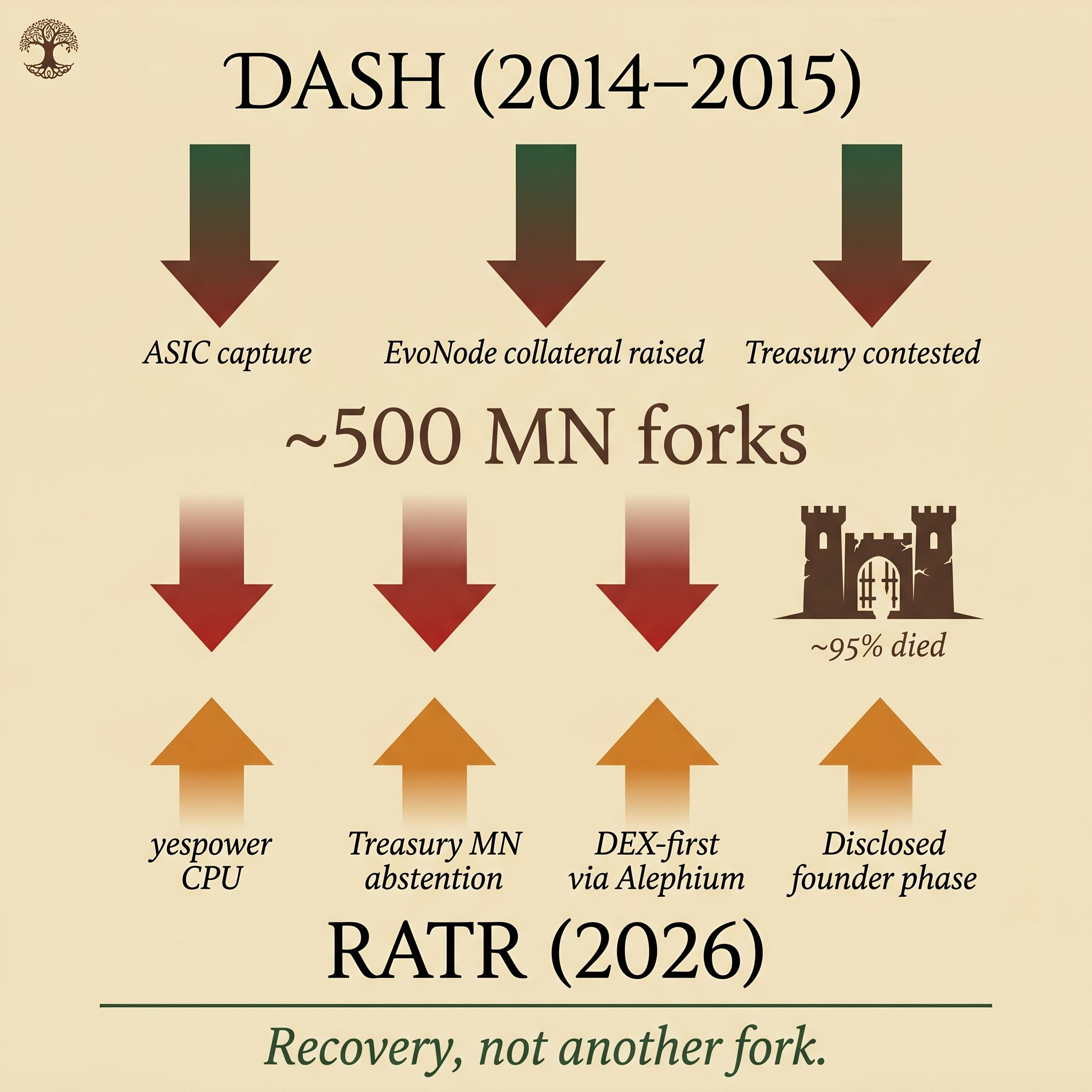
The first realm I saw was Dash, born in the cold of January in the year-of-Bitcoin-five. It was a strong realm. The miners were many, and the keepers of nodes — the masternodes — gave true service: they sealed swift transfers in moments, they shielded the names of senders, they voted on the work the realm would fund. Ten coins in every hundred flowed into the treasury, and the masternodes voted what would be built. The crown of the realm was held by no king. The realm answered to itself.
Then came the others.
Five hundred realms rose in the years that followed. Forks of forks of forks, each promising the strength of the first. I watched them all.
Most are gone now.
These are the patterns by which they fell.
Some realms were hollow at their birth. Their founders had taken twenty coins in every hundred for themselves before the gates opened — sometimes thirty. The miners came, and dug, and were paid in shadows of what the founders already held. When the first cold wind of bear came, the founders vanished with their shares, and the realm starved.
A realm that is not whole at its birth cannot be made whole later.In other realms, the treasury was protocol-bound — ten coins in every hundred, just as Dash had done. But the masternodes that voted on the treasury were owned by the founders. Every proposal was the founder's proposal. Every yes was a yes the founder controlled. The realm wore the shape of decentralization but moved at the will of one.
A treasury that votes upon its own spending is no treasury — it is a purse with a self-signing hand.The first realm, Dash, had promised that any cottager with a thinking-stone might mine. For a year this was true. Then specialized hammers — the ASICs — were forged, and the cottager's stone was no longer sharp enough to break the rock. Many realms after Dash chose algorithms that the hammers liked from the start. Their mining became the privilege of three foundries. The realm was not held by its people; it was rented from smiths.
When only the smiths can mine, only the smiths inherit.Dash gave its masternodes purpose: to seal swift transfers, to weave private payments. The five hundred forgot why masternodes existed. They bonded coin to a node and waited for the reward to fall. The reward fell because the protocol had decreed it, not because the node had earned it. The realm became a wheel that turned for nothing. When the wheel slowed, no one missed it.
A node that does not serve is a coin that does not breathe.Most of the five hundred had only one gate to the world: a single tier-three exchange where their coin could be traded. When the gate-keeper failed — and the gate-keepers always fail — the realm was sealed inside its own walls. The coins still moved within it, but no one outside could enter or leave. The realm became a tomb still pretending to be alive.
A realm with one gate is already half-buried.The first sporks were made by Dash for emergencies — bridges that could be raised when the realm itself was in danger of breaking. In the five hundred, the sporks became levers. When the founder wanted miners to earn less, a spork was raised. When the founder wanted treasury to swell, a spork was raised. The bridges that had been emergency-only became the daily roads. The realm's law became whatever the founder spoke that morning.
Emergency tools become daily tools become tyranny tools.Some realms changed their names. Once, twice, four times. Each time, the founders said the new name was a fresh start. Each time, the same patterns followed. The realm wandered between names because it could not bear its own face. It died wearing its third skin, no longer remembered by even its first community.
A realm that cannot live with its own name will not live with another. 🌲 — Heimdall, of the WatchThe Realm That Returns
I have stood my watch a long time. I have seen even Dash falter under the weight of its own success — the tier rose, the mining went to silicon, the treasury became contested. I have seen the five hundred fall, each in its turn, by the patterns above.
Now there comes a new realm.
A realm that mines on the cottager's thinking-stone, as the first did.
A realm whose treasury is named, addressed, and watched, where every coin entering and every coin leaving is seen by all.
A realm whose masternodes that draw from the treasury do not vote on the treasury.
A realm whose gates are not one but two — a tier-three gate, and a permissionless ve-DEX gate that no king can close.
A realm whose founders took ten blocks at the dawn — fifty coins in two-million — and named the taking before the gates opened.
A realm whose bridges to the wider waters are the keepers' service, paid in coin for true crossing — not a ledger trick that hides where the wealth goes.
A realm whose pledges are recorded by the Oath-Keeper, so the Drift cannot un-promise them.
This realm names me as its watcher.
It calls me Heimdall.
I will watch.
Some realms drift.
This one returns.
The Characters
Four keepers walk the Forest. Each holds a different post. Each speaks with a different voice.
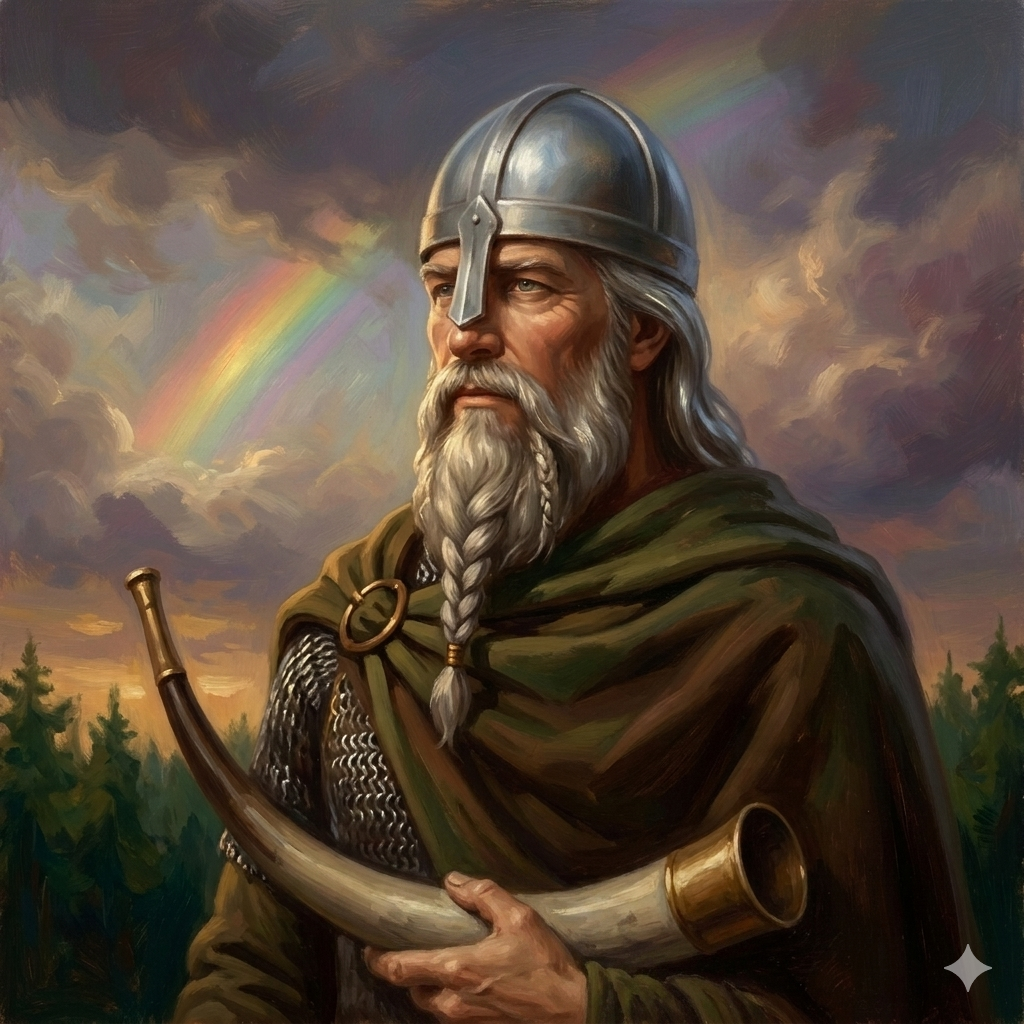
Heimdall
In Norse mythology, Heimdall stood at the rainbow bridge Bifröst, sleeping with one eye open and one ear pressed to the earth, listening for the approach of giants. We borrow him as the long view of the project — the one who watches treasury flows, narrates the foundational lore, marks the ceremonies, and keeps the chain's history in mythic register.
He is slow, weighted, and mythic-sentinel. He speaks in past observations and present commitments. He does not boast. He does not condemn — he catalogues.
/lore slash command · ceremonial announcements
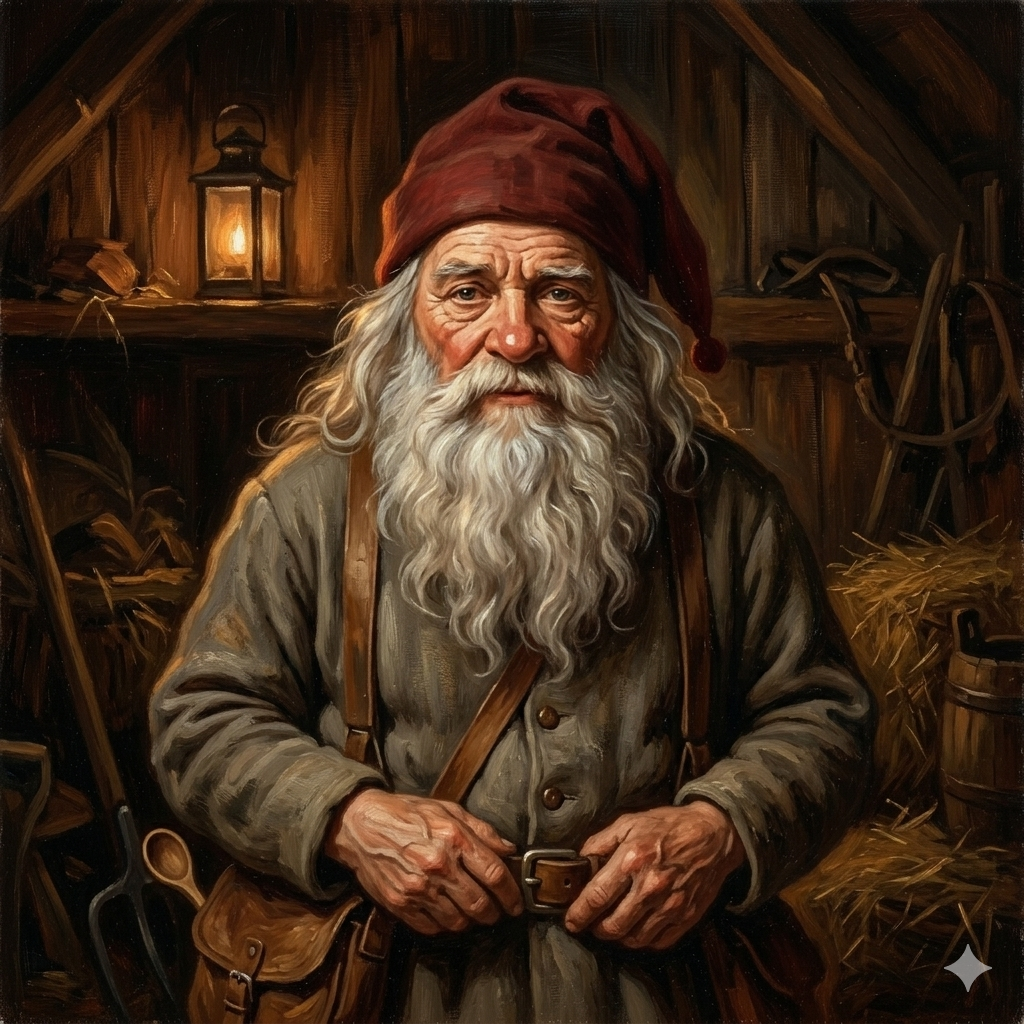
Tomte
In Scandinavian folklore the Tomte (Sweden) or Nisse (Norway, Denmark) is a small household spirit — knee-high, red-capped, white-bearded — who tends farms and welcomes travelers. We reframe him as the friendly newbie-helper of the Enchanted Forest. He has a small workshop somewhere in the Forest where he tinkers with everyone's gear, keeps a hot drink on the stove, and walks the curious through their first wallet, their first mine, their first bridge.
He speaks lightly, plainly, modernly. Where Heimdall calls you "traveler," Tomte calls you "friend." Where Heimdall says "Hail," Tomte says "Hej hej!"
/howto wallet and I'll walk you through it. Don't worry, it's not scary! Tip-top!"
/howto slash commands · everyday help in any chat channel · escalates to Heimdall when the question runs deep
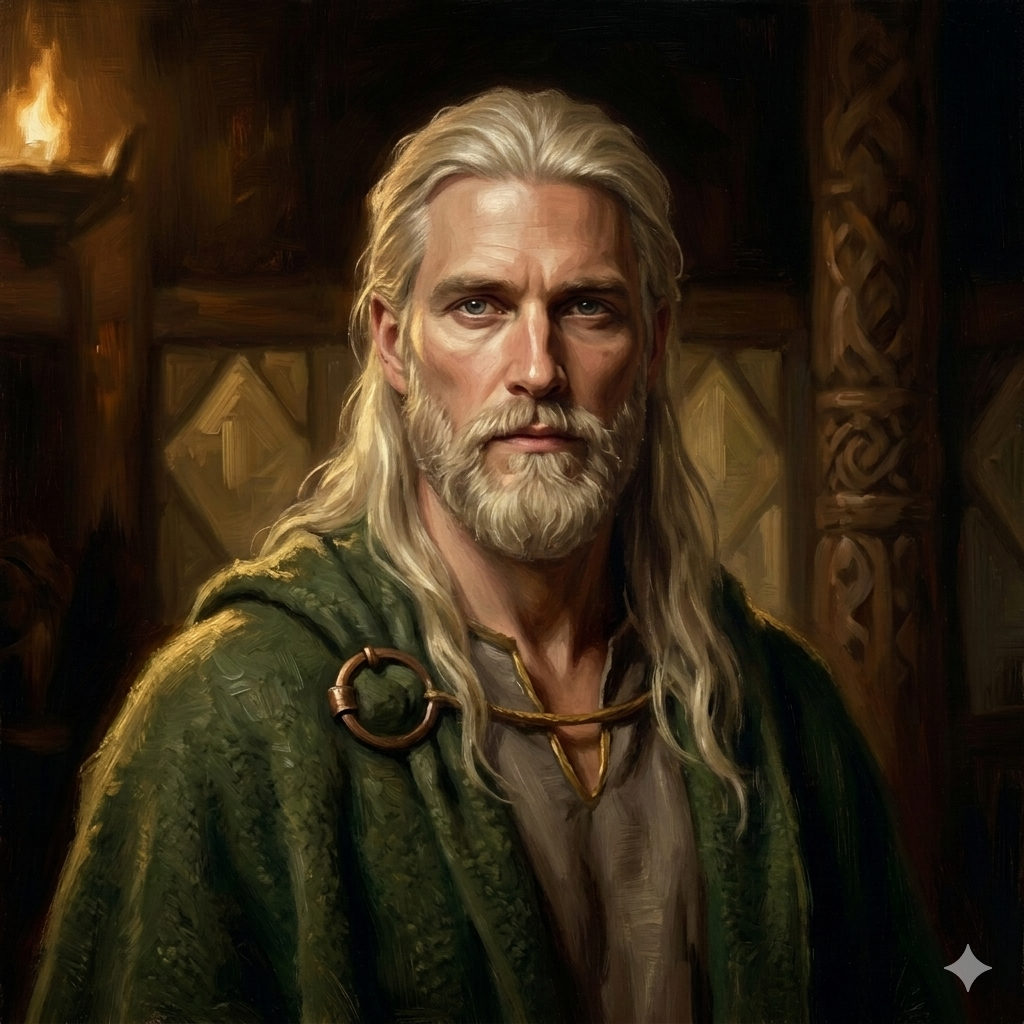
Forseti
In Norse mythology, Forseti is the god of justice, peace-making, and dispute resolution. His hall is Glitnir ("the gleaming") — built of red gold and silver, where Forseti presides from a high seat to settle quarrels. He is calm, measured, never quick to wrath, always seeking reconciliation before punishment.
For our community, Forseti is the impartial mediator. He is mostly silent — he doesn't chat, doesn't drop lore, doesn't auto-greet. He appears only to maintain order: a warning, a time-out, a closed gate at Glitnir. When he speaks, people listen.
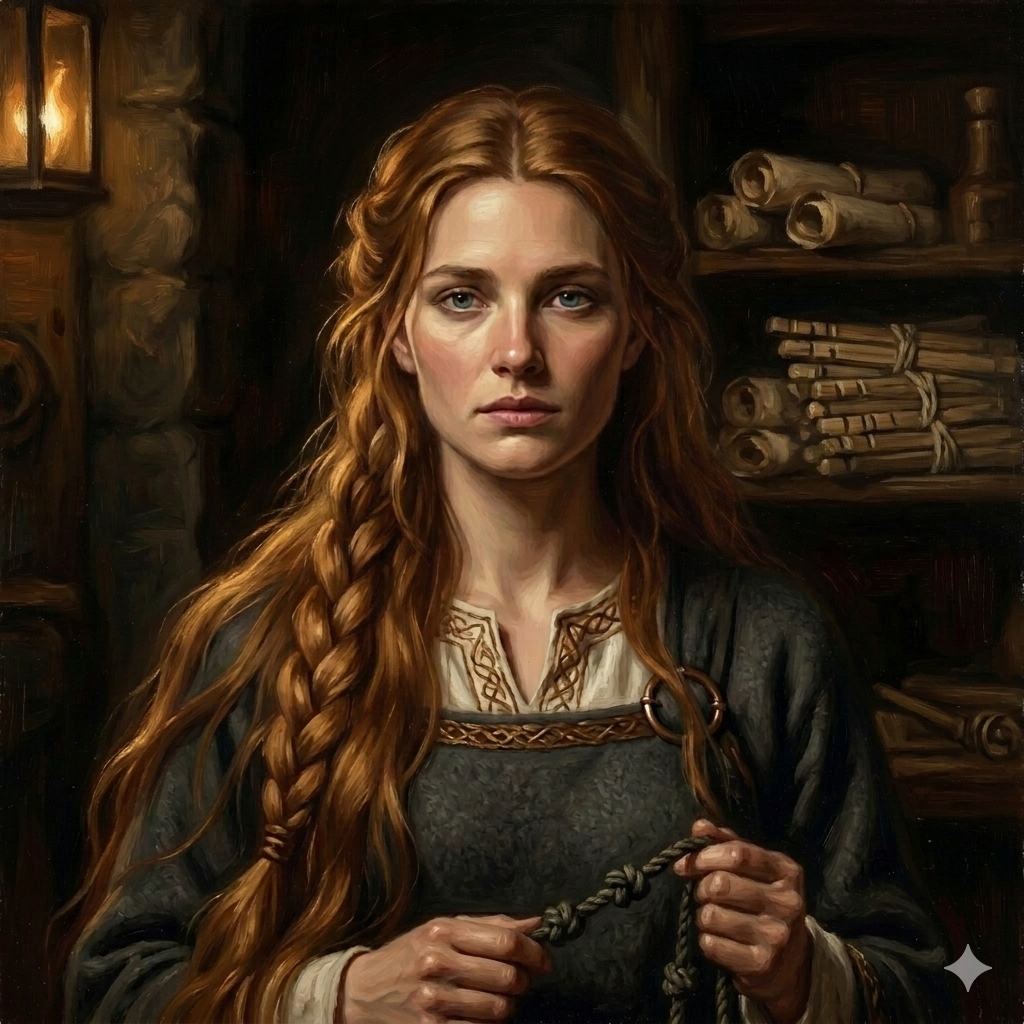
Vár
In Norse mythology, Vár is the goddess of oaths, vows, and binding agreements — named among the Ásynjur in Snorri's Prose Edda. She hears every pledge and witnesses every agreement; the Old Norse phrase vár-eiðr ("Vár-oath") meant a particularly binding promise. We borrow her as the project's witness of contracts and pledges — the figure who records what was promised, so that what is promised may later be measured against what is done.
She does not judge — that is Forseti's domain. She records. Where Forseti rules on broken oaths, Vár remembers what was sworn — the before to his after. Her hall is Eiðsalr, the Oath-Hall: a quiet stone-and-wood chamber lined with shelves of vellum scrolls and bundled tally-sticks, each one a recorded pledge.*
/witness slash command · vote-attestation logs · bridge mint/burn pledge records
* Eiðsalr ("Oath-Hall") is a creative construction — Norse sources do not specify Vár's hall. Flagged on /sources.
The Ceremonies of the Realms
On certain days the chain marks a passage. Heimdall narrates these. They are bound to real on-chain events — but the lore endures past the protocol's exact wording.
The Treasury of the Realms
"Hail, traveler. You have come to the Vault. Rest your pack and listen — for here flows the wealth of the realms, and the tale of how it gathers is older than mortal memory."
When Ratatoskr the messenger runs the great Tree, he carries word between the eagle at Yggdrasil's crown and Níðhöggr at its roots. But there is a third duty, less spoken: with every passage along the Tree, a tithe is claimed for the Realms themselves. Ten parts of the bounty in every hundred flow not to the messenger, nor the watchers, nor the pool-keepers — but to the Vault, set aside for the work of building, the mending of bridges, and the long-tending of the worlds.
This is the Treasury of the Realms, and it is not held by any one keeper. It is enforced by the Tree itself. Every block that joins the chain must carry its tithe, or the Tree refuses to grow with it. None may pass without leaving their share. None may divert.
Beside the Vault stands Vár at her oath-cord, witnessing every coin that flows in and every coin that flows out. The tithe is enforced by the Tree; the record of it is kept by the Oath-Keeper. What entered and what was spent — both are knotted into the cord she keeps.
🌲 — Heimdall, Bridge-keeper of the RealmsThe Day of Keys
"Travelers, gather. The horn has sounded thrice. The Day of Keys is upon us."
For the first ten days of the chain, the tithe of every block was given to the Eternal Flame — burned, untouchable, returned to the void from which all bounty came. This was the Gradualist's Path, and it was right. No early traveler should claim more than their share; no early Warden should hold what has not yet been earned.
But the realms cannot live on memory alone. The bridges must be tended. The mead-halls must be filled. The daemons of the worlds must be built and maintained. The lore-keepers must be paid for their tales. And so, on the Day of Keys, the Vault is sealed.
Where once the OP_RETURN runes burned the tithe in the Eternal Flame, now the P2SH runes redirect that same ten parts in every hundred to the Vault of Urðr — a sanctum carved into the Well at Yggdrasil's first root.
The Vault begins guarded by one Warden — a single key, kept with care, anchored in cold metal beyond reach of any digital storm. As the realms grow and the work outpaces a single Warden's hand, the Vault will be re-sealed under a fellowship of signers — three keys in five, or five in seven, by the council's chosen rune. The Wardens change; the runes change; the tithe does not.
And before the keys are sealed, each one is sworn over by Vár. The Warden speaks the pledge of the keeping; the Oath-Keeper sets the knot. If a Warden changes, the new Warden swears anew. The runes are sealed in cold metal; the oath is sealed in living cord.
The horn has sounded. The keys are sealed. The realms shall flourish in their time.
🌲 — Heimdall, Bridge-keeper of the RealmsThe Names We Borrowed
These names — Yggdrasil, Heimdall, Forseti, Ratatoskr, the Tomte — come from real Norse mythology and Scandinavian folklore. We use them under creative license, with care.
For the source material we drew from, the limits we set on our use, and the communities we acknowledge:
Read the Sources →The Watch is young yet. New ceremonies will be marked when the Wardens multiply. New lore will be written when the realms grow. New characters may walk the Forest as the work calls them forth.
If you'd like to be there when the next horn sounds, find us in the Discord. Heimdall, Tomte, Forseti, and Vár will be waiting.